

The Best UAD Plug-Ins for Producers in 2026

Universal Audio plug ins are popular for one reason that matters: they get you to record sounding mixes faster. Not magic. Not hype. Just tools that behave like classic studio gear in ways producers actually use.
This guide is designed for two types of people at once:
Total beginners who want a simple first toolkit
Experienced producers who want the shortest path to consistent, polished mixes
You will get:
The best UAD plug ins to cover 90 percent of real mixing needs
The simplest buying path that avoids wasting money
Starter chains you can copy today
A simple breakdown of UADx, DSP, and Spark so you do not buy the wrong thing
Key takeaways - Buy plug ins by job, not by name - Start with LA 2A, 1176, and Pultec for the biggest upgrade per dollar - Use one great reverb on a send instead of stacking many inserts - Native UADx is usually enough for mixing, DSP matters most for tracking - A small toolkit you know deeply beats a huge toolkit you barely use
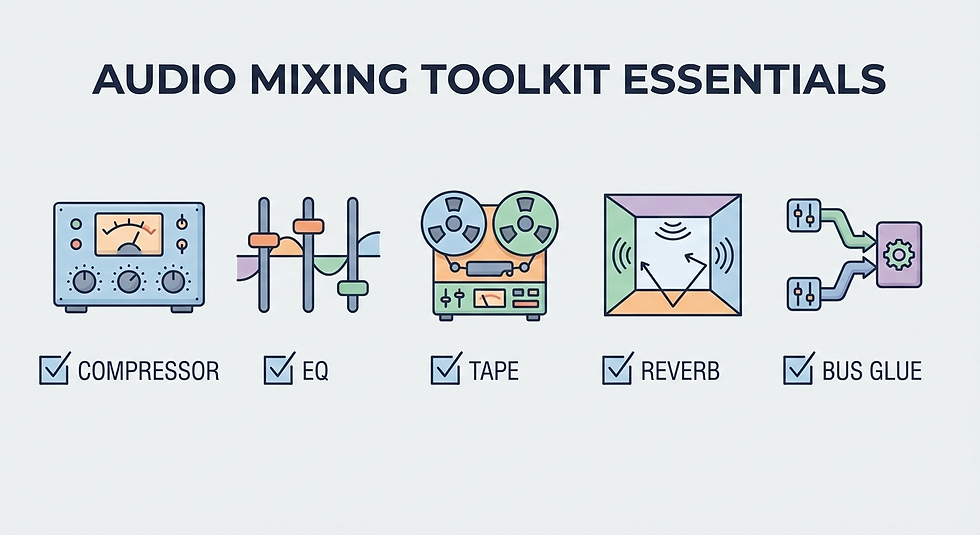
Table of contents
The one idea that changes everything
The short list: the first 7 UAD plug ins that cover almost everything
Best UAD plug ins by category
Starter chains you can copy today
UADx vs DSP vs Spark in plain language
Buying paths that avoid regret
Common beginner mistakes
FAQ
Related posts
The one idea that changes everything
Pros get better over time because they standardise.
They pick a small set of tools, learn them deeply, and stop second guessing every move. That is what compounding looks like in audio: fewer decisions, better instincts, faster results.
If you do that with UAD tools, you will start hearing mixes in terms of jobs, not plug in menus.

Most people buy plug ins by name. Pros buy plug ins by job.
There are only a few jobs you need covered:
Levelling dynamics
Shaping tone
Adding harmonics and saturation
Creating space and depth
Gluing buses and finishing the mix
If your toolkit covers those jobs well, you can mix anything.
The short list: the first 7 UAD plug ins that cover almost everything

1. LA 2A style compressor: smooth levelling
Best for vocals and bass when you want control without sounding compressed.
Why it wins
Makes vocals stable and in front without getting harsh
Simple controls, high payoff, beginner friendly
Beginner move
Turn Peak Reduction up until the vocal stops jumping around
Match output level and move on
2. 1176 style compressor: fast punch and attitude
Best for drums, vocals that need edge, and aggressive peak control.
Why it wins
Catches peaks fast and adds energy
Can be clean or nasty depending on how you hit it
Beginner move
Use it first in a chain to catch peaks before smoothing with an LA 2A
3. Pultec EQP 1A: musical tone shaping
Best for adding body, weight, and air without turning the mix into a science project.
Why it wins
Broad moves that sound like records
A tone tool, not a microscope
Beginner move
Use tiny boosts, then stop
If you do not hear it, do not keep turning
4. A channel strip: speed and consistency
A channel strip is a workflow tool. It helps you stop stacking random plug ins and start mixing with intention.
Why it wins
One place to EQ, compress, gate, and move fast
Consistent tone across many tracks
Beginner move
Pick one channel strip and use it everywhere for a month
Learn it deeply instead of buying more
5. Tape for tracks or buses: density and cohesion
Tape plug ins are not only about warmth. They are about controlled saturation and glue.
Why it wins
Helps digital mixes feel more connected
Adds harmonics that create presence without more volume
Beginner move
Put tape on a drum bus or mix bus lightly
Avoid obvious distortion unless that is your aesthetic
6. A clean, flexible compressor for buses
You need something that can do gentle glue without changing the whole vibe.
Why it wins
Bus compression is about subtle control, not smashing
Helps mixes translate across speakers
Beginner move
Keep gain reduction small
If you hear pumping, you are doing too much
7. A high quality reverb that does not get in the way
Reverb is where beginners accidentally destroy mixes. The best reverbs create depth without washing everything out.
Why it wins
Puts things in a believable space
Adds emotion and scale
Beginner move
Use one reverb on a send, not many reverbs on inserts
Filter lows on the reverb return so the mix stays clear
Best UAD plug ins by category
This section is for people who want the why and the use cases, not just a shopping list.
Compressors: control, punch, and vibe
LA 2A style: smooth levelling for vocals and bass
1176 style: punch, snap, peak control
Fairchild style: thick, smooth colour for vocals and mix bus
Distressor style: flexible control from clean to coloured
Pro truth
Stack compressors gently. One catches peaks, one smooths the body. That is how you get loud and controlled without sounding flat.
EQs: tone first, surgery second
Pultec style: broad tone shaping, low end size, top end air
API style EQ: punchy, forward, great for drums and guitars
Clean parametric EQ: surgical fixes when you actually need them
Pro truth
Most EQ should be broad strokes. Surgical EQ is for problems, not flavour.
Saturation and tape: presence without harshness
Studer style: track level density and cohesion
Ampex style: mix bus finishing and polish
Harmonic saturation tools: presence without extra volume
Pro truth
Small amounts on key elements beat heavy saturation on everything.
Reverbs and space: depth that stays clean
Plate style: vocals that feel expensive
Room style: drums that feel real
Lush vintage digital style: wide atmospheric depth
Pro truth
Your reverb return should usually be filtered and quieter than you think.
This section is for people who want the why and the use cases, not just a shopping list.
Best compressors
LA 2A style: smooth levelling for vocals and bass
1176 style: punch, snap, peak control
Fairchild style: thick, smooth colour for vocals and mix bus
Distressor style: flexible control from clean to coloured
Pro truth
Stack compressors gently. One catches peaks, one smooths the body. That is how you get loud and controlled without sounding flat.
Best EQs
Pultec style: broad tone shaping, low end size, top end air
API style EQ: punchy, forward, great for drums and guitars
Clean parametric EQ: surgical fixes when you actually need them
Pro truth
Most EQ should be broad strokes. Surgical EQ is for problems, not flavour.
Best saturation and tape
Studer style: track level density and cohesion
Ampex style: mix bus finishing and polish
Harmonic saturation tools: presence without extra volume
Pro truth
Small amounts on key elements beat heavy saturation on everything.
Best reverbs and space
Plate style: vocals that feel expensive
Room style: drums that feel real
Lush vintage digital style: wide atmospheric depth
Pro truth
Your reverb return should usually be filtered and quieter than you think.
Starter chains you can copy today

Want a chain that fits your exact voice and genre? Send me a dry vocal and one reference track and I will recommend a simple UAD chain with starting settings!
Chain 1: Clean modern vocal that stays steady
1176 style compressor for peak control
LA 2A style compressor for smooth levelling
Pultec style EQ for body and air
Rule
If you need more than this, the recording or arrangement is probably the real issue.
Chain 2: Punchy drums that still feel clean
Channel strip for shaping and punch
1176 style compression for snap
Tape on the drum bus for cohesion
Rule
Do not chase loudness on the drum bus. Chase impact.
Chain 3: Mix bus glue without killing dynamics
Gentle EQ for tiny broad moves
Light bus compression for control
Ampex style tape for finishing
Rule
If the mix gets smaller when you turn the chain on, you went too far.
UADx vs DSP vs Spark in plain language

This is where beginners waste money. Here is the clean breakdown.
Option | What it is | Best for | What to watch for |
UADx (Native) | Plug ins run on your computer CPU | Mixing and producing in the box | CPU load if you stack heavy sessions |
DSP (Apollo, UAD 2) | Plug ins run on UA hardware | Tracking through effects with low latency | Hardware cost, DSP limits per session |
Spark | Subscription that gives access to many native UADx titles | Trying lots of tools quickly, learning before buying | Ongoing cost, some titles may not be included |
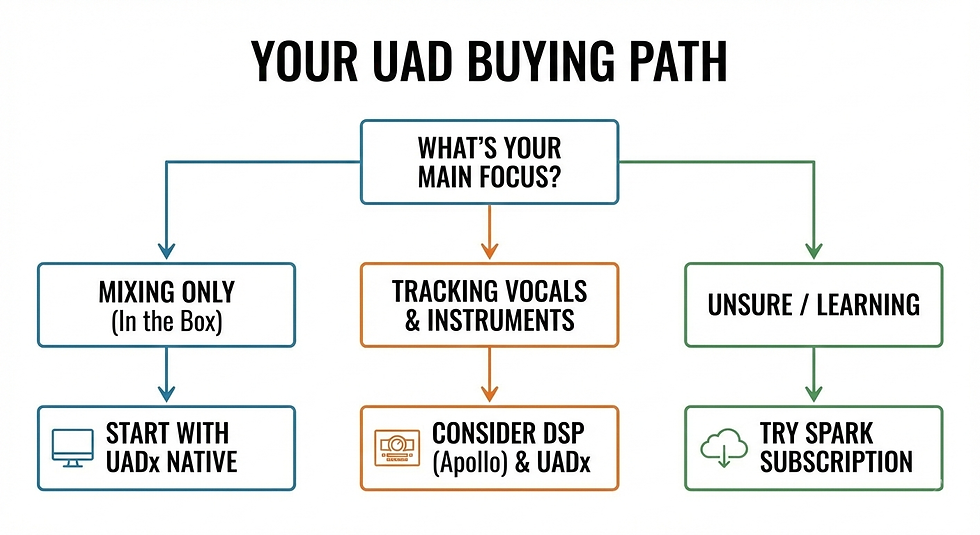
Simple decision
Mostly mixing and producing: start with UADx native
Recording vocals and instruments through effects: DSP can be worth it
Unsure what you like yet: Spark can be a safe learning ramp
Buying paths that avoid regret
Path A: Super beginner starter kit
LA 2A style
1176 style
Pultec style
One channel strip
One reverb
Use those for 90 days before buying anything else.
Path B: Producer who wants mixes to translate and sound finished
Tape for cohesion
Mix bus compression
One great reverb
Refine with a channel strip workflow
Path C: Engineer focused on vocals
1176 plus LA 2A combo
Tasteful EQ
Plate reverb on a send
Optional colour compression for flavour
Common beginner mistakes that kill mixes

Compressing too hard because louder feels better
Stacking multiple reverbs instead of using one great send
Boosting highs until it sounds exciting, then wondering why it is harsh
Buying more plug ins instead of fixing gain staging and arrangement
FAQ
What should I buy first if I only have money for one?
An LA 2A style or 1176 style compressor. If you make vocal forward music, LA 2A first. If you make drum heavy music, 1176 first.
Do I need UA hardware?
Not always. Many tools are available natively as UADx. Hardware matters most for tracking workflows.
How many UAD plug ins do I actually need?
A small set you know deeply will beat a huge set you barely understand.
Final note
The best plug in is the one you can reach for instantly, understand, and trust.
I am building a full UAD series with step by step chains for vocals, drums, mix bus, mastering, plus buying guides for UADx, DSP, and Spark.
If you want me to dial in a chain for your voice and genre, send me a dry vocal and a reference track and I will recommend a simple chain that works. ✌🏼


Great read!